

AI capability isn’t demonstrated by the prompt – but by the system
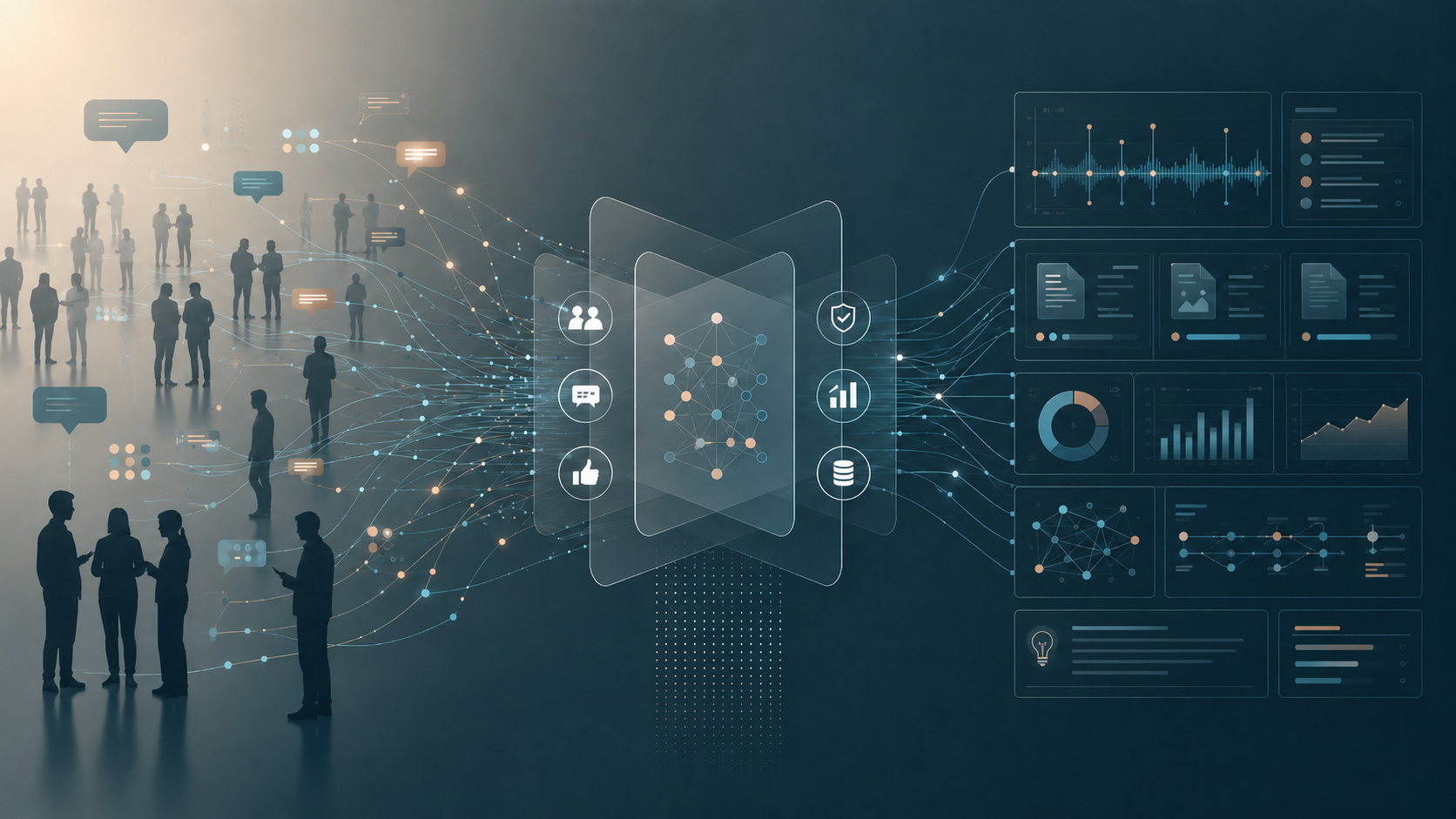
When people talk about artificial intelligence today, they often mean generative AI in particular: writing texts, summarising content, generating images, formulating ideas. That is useful – but only part of the picture.
For us, AI becomes truly exciting when it not only produces content but is integrated into real-world product logic: using data from various sources, technical constraints, incomplete signals, and the requirement that results remain traceable and robust.
It is precisely these kinds of challenges that we are currently addressing as part of our development project SwingView. At its core, the aim is to derive actionable insights from video, audio and event data – not as a demo, but as a functioning system under real-world conditions.
What does this have to do with crowd-creation and our community solutions? At first glance, perhaps not much. On closer inspection, a great deal.
For the underlying challenge is strikingly similar:
How can many individual, initially unstructured signals be captured, linked and evaluated in such a way that meaningful insights emerge?
In digital communities, these are posts, discussions, ratings, reactions and feedback. In an AI-related development project such as SwingView, they are video, audio and motion data. The data types differ – but the mindset behind them does not.
In both cases, the aim is not to simplify complexity, but to make it manageable: through a clean structure, through comprehensible logic, through iterative improvement and through the conscious use of AI where it creates real added value.
Our experience from current development work therefore confirms one point very clearly:
Anyone who wants to seriously integrate AI into products and processes needs more than just good prompts.
What is crucial is an understanding of the system, data logic, validation, context sensitivity and the ability to use machine support in such a way that results are not only impressive but also practically usable.
This is precisely where we see the connection between community intelligence and AI expertise: not in the buzzword, but in the practical ability to create comprehensible guidance from complex data.
Or to put it another way:
AI expertise is not demonstrated where a tool generates something at the touch of a button. Rather, it is demonstrated where technology becomes a robust system.